
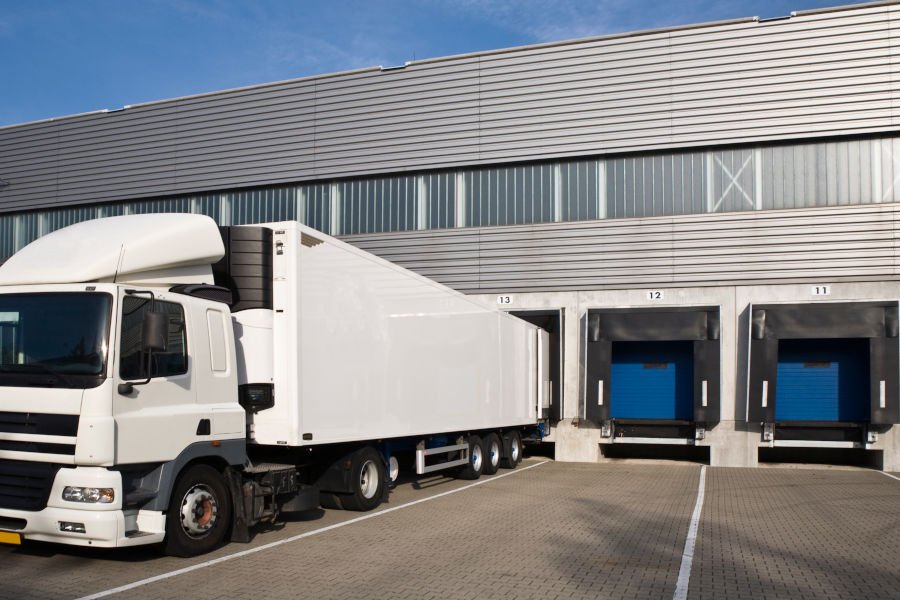
Truck Courts and Dock Aprons for Northern Colorado Freight Buildings
Semi-trailers swing wide, and the pavement beneath them takes a beating that a parking lot never sees. The truck court is the part of an industrial site where wheel loads concentrate, where tractors turn on a single axle and where landing gear presses a point load into the surface of a parked trailer. We build these areas with that punishment in mind: a prepared subgrade, a pavement section sized for the truck traffic and joints that will still be sound when the second tenant takes the building.
The highway system around Fort Collins gives industrial owners plenty of reasons to build truck-heavy sites. I-25 runs along the east side of the city, US 34 connects Loveland to the interstate and onward to Greeley, and US 85 crosses it at Evans. Wherever those roads meet industrial land, the dock apron and truck court become the most heavily used part of the property.
Apron, Court, Trailer Stalls and Drive Lanes
A freight building usually has several distinct pavement zones, and each deserves its own section. The dock apron nearest the doors takes the most turning and braking, and is almost always concrete. The truck court needs a durable surface for maneuvering, and the trailer storage area can often be a lighter section as long as the landing gear locations are reinforced. Employee parking and auto lanes are separate again.
We build each zone to the engineer's section and call out the places where details commonly fail: the transition between the building slab and the apron, joints at dock-leveler pits, drainage trench crossings and the edges where concrete meets asphalt. Our approach treats those junctions as the real design problem, since they are where wheels and weather do the most damage. The commercial concrete floors crew often pours the apron too, which keeps jointing patterns aligned with the building slab.
Drainage, Turning Radii and Trailer Parking Ratios
Slope is a central tension in any dock design. Docks need level surfaces for loading, but the court has to drain away from the building. The usual solution is to grade the apron gently away from the doors and collect water at trench drains or inlets in the court. We check the slopes in the field with a level before and after paving, because small errors accumulate into ponded water.
Turning radii are a second recurring issue. A court designed on paper for a certain truck length can be unusable if the tenant runs longer trailers or if parked trailers narrow the lanes. We encourage owners to think about the next tenant as well as the first, and we ask the design team to test the layout against realistic truck movements before the formwork is built.
Industrial Sites Along the Corridors
Industrial growth in the region is concentrated near the interstate and the US highways. A broker listing describes three new industrial buildings on Brantner Road in Evans, built in 2025 near Highways 85 and 34 and I-25, with a first suite of 7,500 square feet available. At Centerra Industrial in Loveland, buildings sit half a mile from I-25 with direct access to US 34.
Evans is also where US 85 meets US 34 at a large interchange with left exits and loop ramps, and the roads that connect sites to it determine how trucks arrive and leave. Owners considering a site there or in Loveland should walk the actual truck route from the dock to the interstate, noting turns, signals and any restrictions.
The Services That Surround the Court
Truck courts depend on neighboring scopes. Our parking lot construction work handles employee and visitor areas that sit next to the court, while distribution center construction brings the building, dock equipment and yard together under one schedule. Fire lanes, lighting, security gates and fencing are also part of a well-planned yard.
Where an owner is planning a cross-dock or terminal, the court layout becomes the building's defining feature. A truck terminal and cross-dock facility may call for hundreds of feet of apron, and the pavement thickness, joint spacing and drainage all need to be consistent along that length. The same discipline applies to logistics fulfillment centers, where trailer counts rise during peak seasons.
Paving Windows and Tenant Dates
Heavy paving is weather dependent. Concrete needs temperatures that allow it to cure, and asphalt needs warm ground and dry subgrades. In northern Colorado that frequently means that paving is a spring through fall activity, and that a building finishing in late autumn may need to wait for a good window. We plan for that by completing as much of the base preparation as possible beforehand.
Owners who lease to logistics and distribution users should also keep the tenant's truck schedule in mind. A tenant that needs the yard on the first day of occupancy cannot accept a muddy court, so the paving schedule often sets the real completion date. A retail chain using the building as a regional hub will care about the same thing.
Keeping Trucks, Crews and Pedestrians Apart
Building a truck court on a site that is already in use, or that will have trucks arriving for early deliveries, demands strict traffic control. We separate construction traffic from delivery traffic where we can, use flaggers and barricades where we cannot, and walk the route with the owner's operations manager before work starts. Pedestrian paths are protected, and workers on foot wear high-visibility clothing in the work zone.
The pavement itself is part of the safety picture. Slopes at dock doors, striping that guides drivers and bollards that protect equipment all prevent accidents long after construction ends. We also confirm that fire department access, hydrant locations and turning clearances survive the paving plan, since a truck court that cannot be reached by an engine is a problem the building official will find.
Plan the Yard With the Building
Send the site plan and the expected truck counts and we will review the court layout, pavement sections and phasing with you.
Questions Owners Ask
Should the dock apron be concrete or asphalt?
Concrete is the common choice at the dock itself because asphalt softens under the heat and weight of parked trailers and gets rutted by turning loaded tractors. Asphalt can work in the lighter-traffic stall area. Owners with long-term hold strategies tend to favor concrete throughout the heavy zones.
How thick should a truck court be?
The pavement engineer sets the section from the geotechnical report and the expected truck count. It is rarely appropriate to copy a section from another site, because subgrade strength differs. We build to the engineer's section and flag any soft subgrade we find.
What goes wrong most often in truck courts?
Joint failures, ponded water and poor subgrade preparation are the most common. Each is largely a construction-quality issue, so inspection and testing during the work matter more than the specification alone. We document subgrade proof-rolling and joint layout before any paving begins.
Can we expand the court later?
Yes, if the original design planned for it. That means leaving dowels in construction joints, protecting utilities, and grading the site so that future expansion drains properly. Raise the question during design, since retrofits are far more costly.
Do you coordinate with the dock equipment supplier?
We coordinate leveler pit locations, door openings and bumpers with the supplier so that the concrete is placed once. Mismatches between pit dimensions and equipment are one of the more frustrating errors in a freight project.