
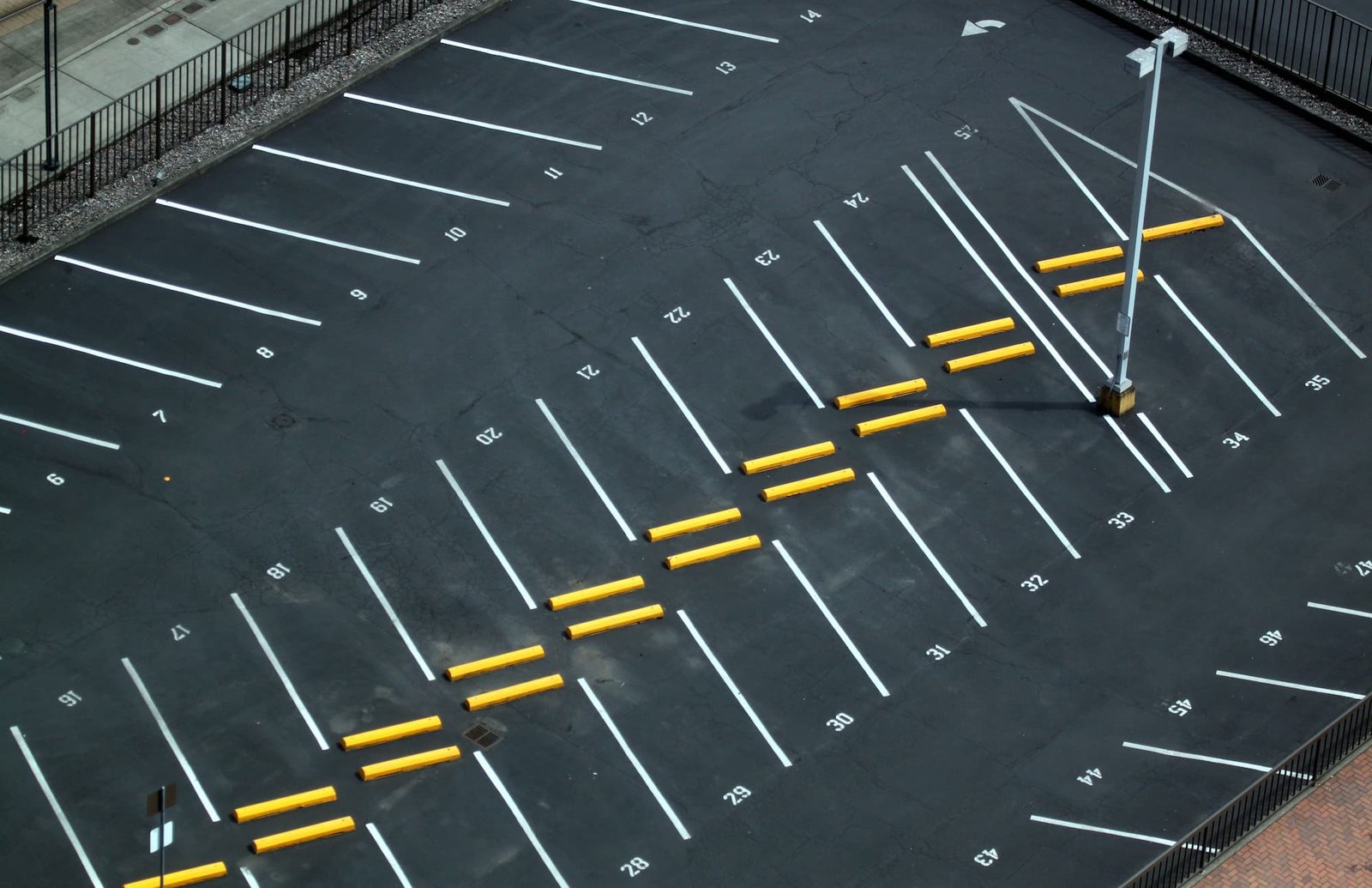
Parking Lot Construction for Commercial and Campus Sites
A 2013 city study of Harmony Road looked at about $53 million in potential improvements, with projected job growth of 70 percent and residential growth of 41 percent along the corridor over 20 years. Proposals included widening four-lane sections, raised landscaped medians, buffered bike lanes and continuous sidewalks. Parking sits at the center of that picture. Every new employee and every new customer needs a space, and every space has to connect to a street that is also being rebuilt.
We build parking lots with an owner's long-term maintenance cost in mind. A lot that looks acceptable at ribbon cutting and is cracked, ponded and faded in five years is not a good lot. Our work focuses on the parts that are buried: subgrade, base, drainage and edge details. Those determine how the surface performs, long after striping is repainted.
Parking in a University, Office and Retail Market
Colorado State University reported an all-time high fall 2025 enrollment of 34,412 students, and the university is the largest employer in Fort Collins. That scale creates a continuous need for parking, drop-off zones and bicycle facilities on and near campus. Meanwhile, the MAX bus rapid transit line, which began service in May 2014, runs parallel to College Avenue from downtown to a transit center just south of Harmony Road, and shapes how some owners think about parking ratios.
In Timnath, the Plaza at Riverbend was announced as a 39,000 square foot, two-building commercial condo project at Harmony Road and Signal Tree Drive, less than a mile from I-25, and the town's first neighborhood commercial development. Smaller retail centers like that live or die by the convenience of their parking, and a well-laid-out lot is part of the pitch to tenants.
From Subgrade to Striping
The scope begins with subgrade preparation: removing unsuitable material, compacting to the geotechnical recommendation and proof-rolling to find soft spots. Aggregate base is placed and compacted in lifts, and the surface is paved with asphalt or concrete as designed. Curb and gutter, sidewalks, ADA ramps, wheel stops and striping complete the lot.
We treat the details that people notice. ADA routes must be exactly sloped, so we check them before paving, not after. Drainage must reach the inlets without birdbaths, so we survey as we go. Concrete curbs are formed with joints in the right place, and asphalt edges are compacted tightly to resist raveling. The work reflects the same care we apply to the building itself, and often involves the same stormwater and drainage team.
Why Two Parking Lots Cost Different Amounts
The pavement section is the largest driver. A lot for passenger cars needs a lighter section than one that sees delivery trucks and trash collection, and the cost difference is real. Subgrade condition is the second driver; a site with soft soil may need stabilization or a thicker base. Third is drainage, since the number of inlets and the length of pipe can add up quickly.
Owners often ask whether concrete is worth the premium over asphalt. The answer depends on the use and the time horizon: concrete lasts longer and handles heavy loading, while asphalt is cheaper at installation and easy to repair. For the drive aisles in a retail shopping center, we usually price both and let the owner weigh the long-term cost.
Coordinating with Utilities, Landscape and Lighting
A parking lot is crowded with other trades. Light pole bases, underground conduit, irrigation sleeves, utility crossings and landscape islands all need to be located before paving starts, because cutting a new asphalt surface is an unwelcome expense. We build a coordination drawing and review it with each trade, so that nothing is added after the base is finished.
In large campus work, we plan around the academic calendar. A university or school district owner often needs the lot to be available at specific times, and construction in the summer is much easier to schedule than during the semester. We will phase the work to keep a portion of parking open, and we communicate closures clearly. Our parking structure construction experience also helps owners compare a surface lot with a structure on constrained sites.
Where We Pave
We build lots for owners across the northern Front Range, from the Harmony corridor to Timnath and out to the I-25 interchanges. If your project is in the Harmony Road corridor, you may be dealing with a street frontage that the city has plans to improve, so we review the right-of-way and access points with you early.
Education, retail and property management owners make up much of our parking work, and we are comfortable with the scheduling and communication that each requires. Owners at an education institution need predictable closures, while retail chains need the lot ready before a grand opening. Either way, we plan the pavement as part of the building's opening date, not as an afterthought.
Existing Conditions, Utilities and the Neighbors
Retrofits and expansions of existing lots bring conditions that new construction does not. Old asphalt sits on a base of unknown quality, utilities cross the site at unrecorded depths and tenants are using the space we need to close. We start with a survey, utility locating and a few test pits, then prepare a phasing plan that matches the opening hours of the businesses nearby.
Neighbors matter too. Dust, noise and detours affect adjacent owners, and a short conversation before the work starts goes a long way. Along corridors like Harmony Road, where the city has studied wider roads and new medians, we confirm that site access points will remain valid as the street is rebuilt, so that the owner's new curb cut is not the next one to be moved.
Pave With the Long View
Share your civil drawings and we will walk through the pavement sections, drainage and phasing for your lot.
Questions Owners Ask
Is asphalt or concrete better for a commercial lot?
Asphalt costs less to install and is simple to patch, so it is the default for car parking. Concrete costs more but resists rutting, which makes it the choice for dumpster pads, bus lanes and truck routes. Many lots combine the two, using concrete only where loads are heaviest.
When is the best time of year to pave in northern Colorado?
Late spring through early fall is the usual window, since asphalt needs warm temperatures and a dry base. Concrete is more flexible but still needs protection in cold weather. We can often prepare base in cooler months and pave when the weather allows.
How do you keep an existing lot open during construction?
We divide the work into phases and keep a portion of the lot available while another is rebuilt. Temporary striping, signage and pedestrian routes are set up for each phase. We coordinate closures with the owner so customers and employees know what to expect.
What do you need to price a new lot?
The civil set, the geotechnical report and the pavement design are the starting point. We also need to know the expected traffic, including delivery vehicles, so we can confirm the section is appropriate. Any utility work in the lot should be on the drawings.